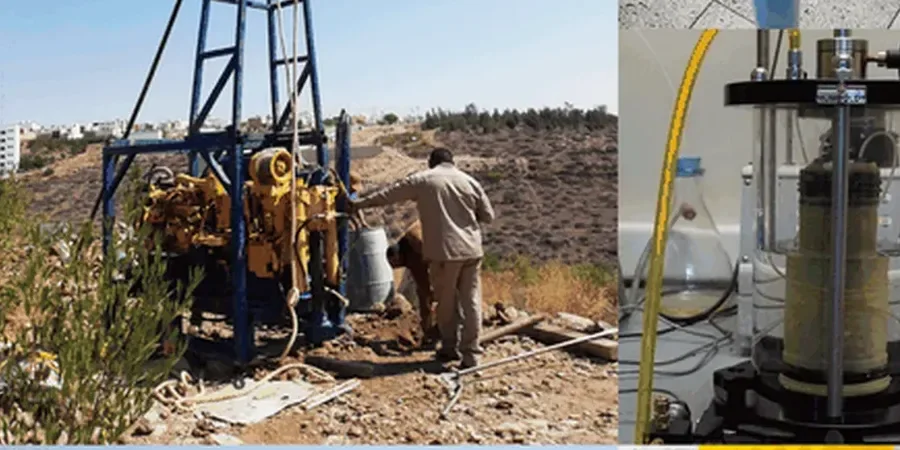
Getting the foundation right starts with understanding what lies beneath. In Santa Rosa, where the soils range from expansive clay to alluvial sediments shaped by Santa Rosa Creek, a soil mechanics study isn't just a permit requirement — it's the backbone of your project's safety. The International Building Code (IBC) and ASCE 7 mandate a thorough geotechnical investigation before any structural design moves forward. We've seen projects stall for months because the initial testing missed a compressible layer at depth. That's why our approach focuses on full profile characterization, from surface to bearing stratum. Before breaking ground in neighborhoods like Rincon Valley or near the downtown corridor, integrating a CPT test can offer a continuous record of soil behavior, while a seismic refraction survey helps map bedrock depth across the site.
In Santa Rosa, the difference between a standard report and a thorough soil mechanics study is often the number of feet between your foundation and the water table.
Site-specific factors
A developer broke ground on a three-story mixed-use building off Mendocino Avenue without a site-specific soil mechanics study, relying instead on a generic county report from an adjacent lot. During excavation, the contractor hit a pocket of soft organic silt that the county map never showed. The differential settlement that followed cracked the slab and delayed the project by four months. That scenario plays out more often than it should in Santa Rosa, where the subsurface can change dramatically within a hundred feet. The financial risk of structural distress, coupled with California's strict liability for geotechnical engineers of record, means that skipping a proper investigation is a gamble no one should take. For sites with poor near-surface soils, we often explore stone columns as a ground improvement alternative to costly deep foundations.
Questions and answers
How much does a soil mechanics study cost in Santa Rosa?
For a standard residential or light commercial project in Santa Rosa, a complete soil mechanics study typically ranges from US$2,840 to US$5,250. The final cost depends on the number of borings, laboratory tests required, and the complexity of the seismic analysis.
How long does a soil mechanics study take from start to finish?
Fieldwork usually takes one to two days on site. Laboratory testing runs another two to three weeks. We deliver the final report with foundation recommendations within three to four weeks after the field work wraps up.
Does the IBC require a soil mechanics study for a single-family home in Santa Rosa?
Yes. The California Building Code, which adopts the IBC with state amendments, requires a geotechnical investigation for all new structures. The building department will not issue a permit without a soil report stamped by a licensed geotechnical engineer.