← Home · Laboratory

Atterberg Limits Testing in Santa Rosa, California

Together, we solve the challenges of tomorrow.

LEARN MORE →

Santa Rosa's alluvial soils tell a complex story. The Santa Rosa Plain, crossed by the Russian River tributaries like Santa Rosa Creek, deposits fine-grained sediments that challenge foundation design. These silts and clays react dramatically to water. A dry summer turns them to brick. A wet winter transforms the same material into a sticky, expansive mass. This behavior is not a mystery when you quantify it. Standard penetration testing with SPT drilling provides disturbed samples for index testing. We then apply ASTM D4318 in our accredited laboratory to define the Atterberg limits precisely. The Liquid Limit, Plastic Limit, and derived Plasticity Index become direct inputs for bearing capacity and settlement calculations under Sonoma County's review requirements.

Atterberg limits transform vague field observations into numerical boundaries that govern foundation performance in Santa Rosa's alluvial clays.
Methodology and scope

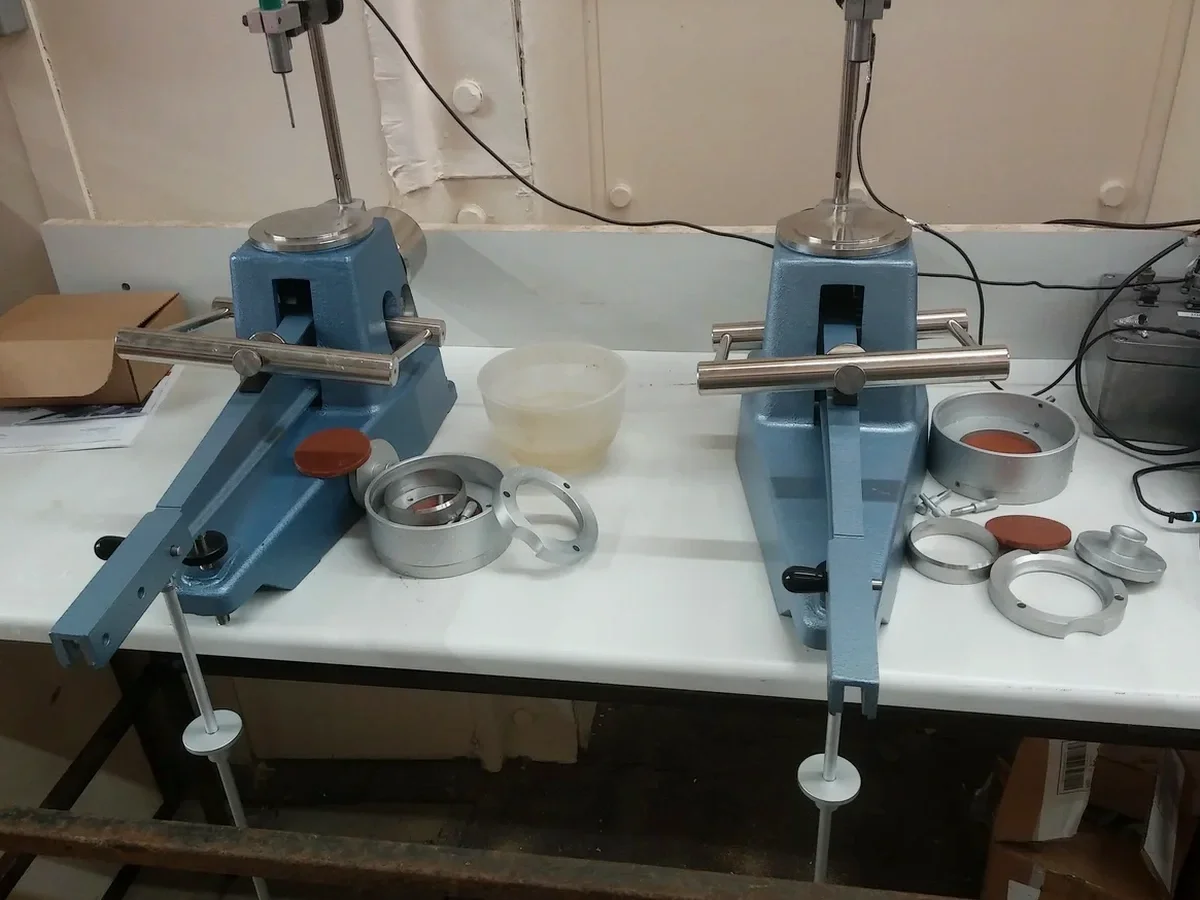
A common mistake in Santa Rosa is classifying a soil by sight alone. Sandy lean clay looks stable in the cut until the first winter rain saturates it. Then the plasticity activates. Slopes creep. Footings settle unevenly. The Atterberg limits test eliminates this guesswork. We measure the water content where behavior transitions from semisolid to plastic, and from plastic to liquid. A Liquid Limit above 50 combined with a Plasticity Index exceeding 25 signals high expansion potential. These values directly feed into the Unified Soil Classification System (USCS) per ASTM D2487. The process requires precise technique: the Casagrande cup method for liquid limit, hand-rolling threads at 3.2 mm diameter for plastic limit. Correlating this data with a grain size analysis completes the classification picture. We also support foundation design by integrating results with footings parameters for cohesive soils.
Atterberg Limits Testing in Santa Rosa, California
Technical reference image — Santa Rosa

Site-specific factors

Santa Rosa sits at an elevation of 164 feet, on the Santa Rosa Plain, with the Rodgers Creek Fault running along its eastern edge. Seismic shaking does more than crack walls. It mobilizes pore pressure in saturated plastic silts. A soil with a high Liquid Limit and a naturally high water content can lose strength almost instantly under cyclic loading. This liquefaction of fine-grained soils is less dramatic than sand boils but equally destructive to shallow foundations. The city's post-fire rebuilding after the 2017 Tubbs Fire brought this into sharp focus. New subdivisions on previously agricultural land encountered deep deposits of fat clay. Ignoring Atterberg limits here means designing blind to the soil's intrinsic sensitivity.

Need a geotechnical assessment?

Reply within 24h.

Email: contact@geotechnicalengineering.biz

Technical data

ParameterTypical value
Test StandardASTM D4318-17e1
Sample PreparationWet or dry method per spec
Liquid Limit DeviceCasagrande cup, manual crank
Plastic Limit Thread3.2 mm (1/8 in) diameter
Number of Points (LL)4 minimum, flow curve fit
Reporting UnitsWater content % (to 0.1%)
Derived ValuePlasticity Index (PI = LL - PL)

Other technical services

01

Liquid Limit (Casagrande Method)

Multi-point determination using the standard brass cup and grooving tool. We plot the flow curve from four or more blows in the 25–35 range and report the water content at 25 blows.

02

Plastic Limit & Plasticity Index

Hand-rolling of soil threads at decreasing moisture until crumbling occurs at 3.2 mm. The difference between LL and PL yields the PI, a key indicator of shrink-swell potential.

03

USCS Classification Package

Combined Atterberg limits and sieve-hydrometer analysis to assign group symbol and group name per ASTM D2487. Delivered as a signed, stamped laboratory report within 3–5 business days.

Relevant standards

ASTM D4318-17e1: Standard Test Methods for Liquid Limit, Plastic Limit, and Plasticity Index of Soils, ASTM D2487-17: Standard Practice for Classification of Soils for Engineering Purposes (Unified Soil Classification System), ASCE 7-22: Minimum Design Loads and Associated Criteria for Buildings and Other Structures, 2019 California Building Code (CBC), Chapter 18: Soils and Foundations

Questions and answers

How much does an Atterberg limits test cost in Santa Rosa?

A single-point test (liquid limit plus plastic limit) typically ranges from US$60 to US$90. The final cost depends on the number of samples in the batch and whether a full particle-size distribution is also required. Most projects bundle 3–5 samples for a comprehensive soil profile.

What soil types in Santa Rosa most need Atterberg testing?

The fine-grained alluvium of the Santa Rosa Plain is the primary target. These include the silty clays and lean clays found near the Laguna de Santa Rosa and its tributary creeks. Any cohesive soil with visible fines should be tested. Soils derived from weathered Sonoma volcanics on the eastern slopes also exhibit surprising plasticity and benefit from classification.

How long does the test take and what sample size is needed?

Laboratory processing is typically 3 business days for a batch of samples. We require approximately 200 grams of material passing the No. 40 (425 µm) sieve for a combined LL and PL test. The sample must be representative and undisturbed or bagged from an SPT split spoon.

Location and service area

We serve projects in Santa Rosa and surrounding areas. More info.

View larger map