The soil profile in Santa Rosa changes drastically within a few miles. Downtown sites near Santa Rosa Creek often encounter loose Holocene alluvium with silty lenses, while projects east toward Rincon Valley sit on stiffer older terrace deposits. This variability means a standard shallow foundation approach fails in many post-1990 commercial zones. The vibrocompaction design has to account for the transition from saturated silty sands at 15 feet depth to denser gravels below 35 feet. Our technical group models these stratigraphic contrasts using pre-design CPT soundings, then defines grid spacing, probe energy, and lift thickness that match the specific fines content of each Santa Rosa parcel. The CPT test provides the continuous tip resistance and friction ratio data needed to calibrate the compaction model before any rig moves on site.
Achieving 70% relative density in Santa Rosa's alluvial sands requires matching vibrator frequency to the soil's critical-state friction angle, verified through pre- and post-treatment CPT soundings.
Process overview
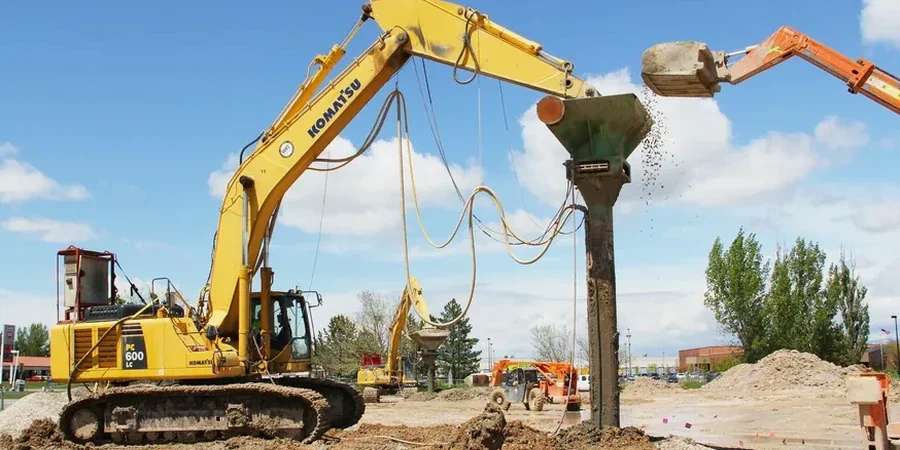
The Santa Rosa Plain sits within the northern San Andreas Fault system, and the USGS Quaternary mapping shows widespread young alluvial fan deposits across the city. Typical SPT N-values in these deposits range from 4 to 12 blows per foot above the water table, which often lies at just 8 to 12 feet depth in the central basin. These conditions demand a vibrocompaction design that achieves a relative density above 70% to control both static settlement and seismic-induced deformation. The process uses a depth vibrator with eccentric weights, advanced in lifts of 2 to 3 feet, with real-time ammeter monitoring to confirm the sand matrix densifies uniformly. For sites where the fines content exceeds 15%, the design logic shifts toward drainage enhancement rather than pure densification, and we integrate the stone columns technique as a complementary ground improvement measure when pore pressure dissipation becomes the controlling factor.
Questions and answers
What is the typical cost range for vibrocompaction design and verification in Santa Rosa?
For a standard commercial lot in Santa Rosa, the combined cost of the vibrocompaction design package and the pre/post CPT verification program runs between US$1,520 and US$5,620, depending on the treatment area and the number of cone soundings required to satisfy IBC acceptance criteria.
How does the high water table in downtown Santa Rosa affect vibrocompaction?
The water table at 8 to 12 feet depth requires the vibrator to work in a saturated environment, which actually aids probe penetration and sand grain rearrangement. The design accounts for hydrostatic pore pressure, and the real-time ammeter data confirms that the saturated sand reaches the target density. Dewatering is generally not necessary for the compaction process itself.
How do you verify that the vibrocompaction design worked?
We run a second round of CPT soundings at the same locations as the pre-treatment tests, then compare cone tip resistance profiles directly. The IBC and ASCE 7 standards require a measurable increase in qc values that corresponds to a relative density above 70%. We deliver a before-and-after comparison report with statistical analysis of the improvement across the entire grid.