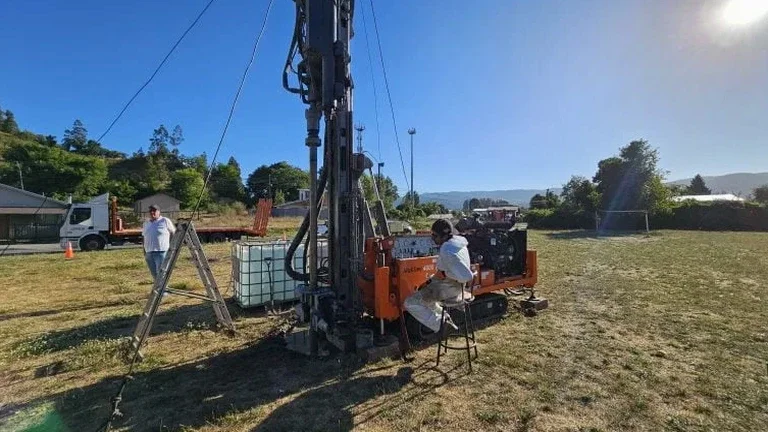
The Santa Rosa Plain sits on a deep alluvial basin fed by Santa Rosa Creek and its tributaries, but just east of the city the terrain transitions to uplifted Franciscan Complex bedrock and landslide-prone slopes. A shallow water table—often within 6 to 10 feet in the lowlands—combined with the city’s location in a high-seismic zone makes visual confirmation of stratification essential before any foundation or utility design. Our exploratory test pit program uses a track-mounted excavator to open trenches up to 14 feet deep, allowing direct observation of soil fabric, moisture conditions, gravel lenses, and clay seams. When the test pit exposes soft bay mud or organic silt, we coordinate with a CPT rig to push continuous cone soundings alongside the excavation and verify undrained shear strength profiles that the trench alone cannot offer. Every pit is logged under ASTM D2487 and referenced to the current IBC Chapter 18 requirements for bearing wall investigations.
A well-logged test pit in Santa Rosa’s alluvium reveals more about bearing behavior than three borings spaced 20 feet apart.
Site-specific factors
The most expensive mistake we see on Santa Rosa projects is assuming that a few shallow hand-auger borings can substitute for a full-depth test pit. In the hillside subdivisions east of Highway 12, augers routinely refuse on cobbles at four feet and miss the underlying landslide debris plane, leaving the slope stability analysis incomplete. A test pit that excavates through the colluvium exposes the actual shear surface and lets the engineering geologist measure dip, striae, and groundwater seepage directly. Skipping this step has led to retaining wall failures and cracked foundations that cost six figures to remediate. The IBC requires 300 square feet of exposure per 5,000 square feet of building area in questionable ground; a single pit often satisfies that requirement while giving the contractor a clear picture of excavation conditions.
Questions and answers
When does the City of Santa Rosa require a test pit instead of borings?
Building officials typically request test pits when the geotechnical report flags undocumented fill, high groundwater, or suspected landslide debris. The IBC allows test pits to substitute for borings where the excavation depth meets or exceeds the planned footing depth and the pit provides the 300-square-foot exposure area per 5,000 square feet of building footprint.
How long does a test pit stay open before it must be backfilled?
We normally log, sample, and photograph the pit within two to four hours and backfill the same day. If a pit must remain open overnight for plate load testing or infiltration measurements, we install a trench box or cut stable slopes at 1.5:1 and fence the perimeter with high-visibility barrier per OSHA 1926 Subpart P.
What is the typical cost range for an exploratory test pit in Santa Rosa?
For a single pit excavated to 10–14 feet, logged by a geotechnical engineer, backfilled with compaction testing, and delivered with a stamped report, the cost generally falls between $520 and $840. The final figure depends on access constraints, traffic control requirements, and whether laboratory testing is bundled with the field work.
Can a test pit damage tree roots on a residential lot?
We locate the pit outside the drip line of protected oaks and other significant trees whenever possible. If the building footprint forces excavation within the root zone, we use hand-digging for the first 18 inches and consult a certified arborist to meet Santa Rosa’s tree protection ordinance requirements.
What happens if groundwater enters the pit during excavation?
We measure the inflow rate and record the stabilized water level on the log. If the pit is being used for bearing observation, we pump from a sump or install a small dewatering well to keep the floor dry during inspection. The groundwater data feeds directly into the foundation drainage and waterproofing recommendations for the project.