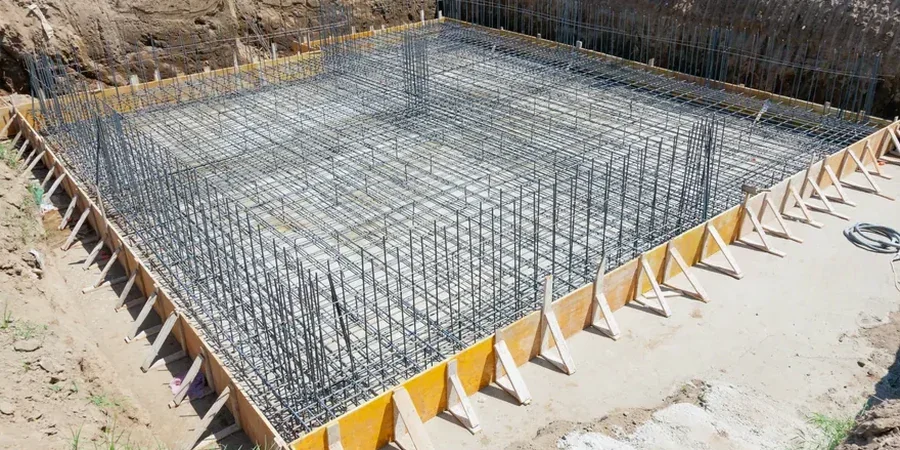
In Santa Rosa, we frequently observe that the difference between a straightforward project and a prolonged legal headache comes down to how you handle the soil. The alluvial fans spreading from the Sonoma Mountains and the Mayacamas have left us with a patchwork of subsoils, from stiff Pleistocene-era clays near Rincon Valley to loose, potentially liquefiable sands along the Santa Rosa Creek floodplain. A standard isolated footing just isn't always the right call here. When you're dealing with variable bearing capacity across a single site, a rigid raft or mat foundation becomes an engineering necessity, not an upgrade. By integrating our local drilling data with in-situ permeability results, we calibrate the slab's stiffness to bridge soft spots without over-excavating, keeping your project on schedule and your budget intact in Sonoma County's competitive construction market.
In Santa Rosa's alluvial setting, a rigid mat foundation doesn't just support a structure; it actively mitigates the differential settlement risk inherent in a basin that has been filling with sediment for the last 10,000 years.
Process overview
The post-1960s expansion of Santa Rosa into the Santa Rosa Plain pushed development into areas with deep Holocene alluvium, fundamentally changing how we approach structural foundations. The 1969 Santa Rosa earthquakes, a pair of magnitude 5.6 and 5.7 events, were a stark reminder that the Rodgers Creek Fault is just to the east, making soil-structure interaction the primary design constraint. A well-designed mat foundation accomplishes two critical tasks simultaneously: it reduces differential settlement on the stratified silts and clays common east of Highway 101, and it provides a solid rigid diaphragm at the base of the structure. This is particularly relevant in the downtown corridor, where older hydraulic fill and loose fluvial deposits sit beneath a dense urban grid. Our design methodology, grounded in ASCE 7-22 and the California Building Code, focuses on calculating the modulus of subgrade reaction specific to your Santa Rosa site. We don't use textbook values. We use data from your soil report to model the slab's flexural behavior under combined gravity and seismic overturning moments, ensuring that the rigidity of the mat compensates for the soil's natural variability without over-engineering the reinforcement layout.
Site-specific factors
A track-mounted geotechnical drill rig on a Santa Rosa site often tells the story before the lab results even come back. You watch the SPT hammer drive a split-spoon sampler through dense gravel at 15 feet, then suddenly it drops 18 inches under its own weight through a loose sand layer. That abrupt change in blow counts is the exact scenario where a conventional spread footing gets into trouble, settling unevenly and cracking the superstructure. Without a unified mat, you're gambling that each isolated footing will behave the same way in soil that clearly isn't uniform. The real risk isn't total settlement; it's differential settlement. A mat foundation bridges these erratic subsurface transitions. In Santa Rosa's liquefaction-prone zones, which align roughly with the historic floodplains mapped by the USGS, a properly designed mat also acts as a flotation restraint and a continuous tie, preventing individual columns from punching through a temporarily weakened crust during a major seismic event on the Rodgers Creek or San Andreas faults.
Questions and answers
What is the typical cost for raft foundation design in Santa Rosa?
For a standard residential or light commercial project in Santa Rosa, the engineering design and soil-structure interaction analysis for a mat foundation typically ranges from US$930 to US$3,960. The final fee depends on the complexity of the subsurface profile, the presence of liquefiable layers, and the level of detailing required for the reinforcement layout.
Is a mat foundation better than a raised floor for expansive soils in Rincon Valley?
In the Rincon Valley area, where expansive Pleistocene clays are common, a properly engineered mat foundation can be an excellent solution. The key is maintaining consistent moisture content. A stiffened mat with deepened perimeter beams will resist the shrink-swell cycles better than isolated footings, but it must be paired with good surface drainage to prevent water from ponding at the edges.
When does the Santa Rosa building department require a mat foundation?
The City of Santa Rosa doesn't typically mandate mat foundations by name. However, when the geotechnical report reveals bearing capacities below 1,500 psf, high groundwater within 5 feet of the bottom of the excavation, or a high liquefaction potential as defined by the CBC, the structural solution almost always defaults to a mat foundation to meet the safety factors required by code.
How do you model the soil-structure interaction for a mat?
We typically use a finite element analysis approach, often using software like CSI SAFE or RAM Concept. The mat slab is modeled as a plate element, and the soil is represented as a series of discrete springs with stiffnesses derived from our site-specific subgrade modulus analysis. This allows us to see where the slab wants to bend and where reinforcement needs to be concentrated.
How long does the design process take for a Santa Rosa project?
Once the geotechnical field investigation and laboratory testing are complete, the analytical design phase for a mat foundation typically takes between 2 to 3 weeks. This includes the iterative process of adjusting the slab thickness and reinforcement to satisfy both geotechnical settlement criteria and structural strength requirements per ACI 318.