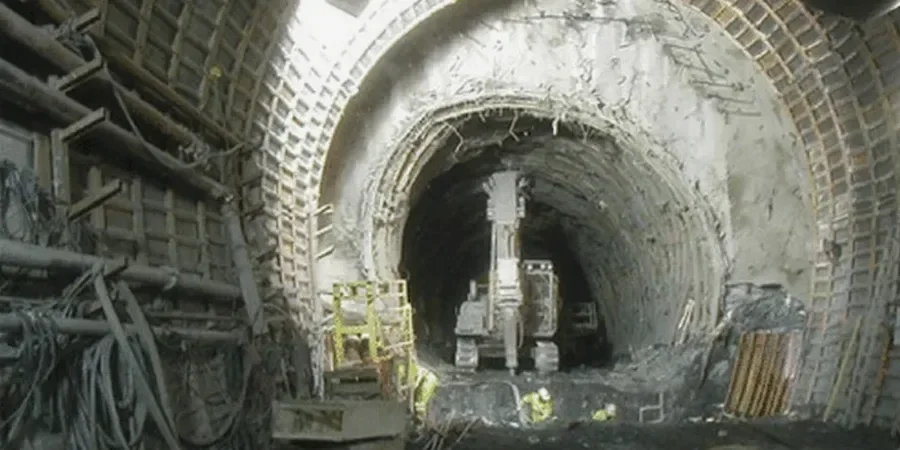
The alluvial plains stretching south toward the Petaluma River aren't just scenic. They're a constant reminder that tunneling in Santa Rosa means negotiating layers of soft, compressible clay interspersed with loose sands. With the city's population hovering near 180,000 and infrastructure expanding to meet pressure from the Bay Area, the need for precise geotechnical analysis for soft soil tunnels has never been sharper. Our laboratory team approaches each project with a grounding in the local stratigraphy—from the Young Alluvium deposits near downtown to the deeper Bay Mud formations encountered in fringe developments. The work doesn't start at the tunnel face. It starts months earlier, with a careful triaxial shear program that maps undrained strength under the exact confining pressures the alignment will see.
In Santa Rosa, the difference between a successful drive and a catastrophic face collapse often lies in a single overlooked clay lens.
Process overview
Crossing from the Laguna de Santa Rosa watershed toward the eastern hills, the subsurface tells two completely different stories. Near Highway 101, we routinely encounter groundwater within six feet of the surface and organic silts that consolidate under minimal load. Over in Rincon Valley, the transition to stiffer alluvial terrace deposits demands a different tunneling approach entirely. A proper geotechnical analysis for soft soil tunnels reconciles these contrasts by characterizing the undrained shear strength, consolidation parameters, and sensitivity of the material. We perform incremental oedometer tests to predict long-term settlement and use index testing to classify the highly plastic clays common to the Santa Rosa Plain. This data feeds directly into face stability calculations and ground loss assessments—vital when tunneling beneath established neighborhoods with shallow utilities.
Relevant standards
ASTM D4767 – Consolidated Undrained Triaxial Compression Test for Cohesive Soils, ASTM D2435 – One-Dimensional Consolidation Properties of Soils Using Incremental Loading, ASCE 7-22 – Minimum Design Loads and Associated Criteria for Buildings and Other Structures, IBC Chapter 18 – Soils and Foundations, ASTM D4318 – Standard Test Methods for Liquid Limit, Plastic Limit, and Plasticity Index of Soils
Questions and answers
What is the typical cost range for a geotechnical analysis of a soft soil tunnel in Santa Rosa?
For a comprehensive laboratory program and engineering analysis supporting a tunnel alignment in the Santa Rosa area, the scope typically ranges from US$3,700 for a basic characterization to US$18,440 for a full suite including triaxial, consolidation, and permeability testing. The final cost depends on the number of borings, testing frequency, and the complexity of the ground profile.
How do you handle the high groundwater table typical of the Santa Rosa Plain?
We characterize the permeability and consolidation properties of the saturated deposits using falling head tests and oedometer tests. This data informs the feasibility of dewatering versus pressurized face tunneling. In zones where the groundwater is within a meter of the tunnel crown, we pay particular attention to the hydraulic gradient and the risk of piping at the face.
Which soil parameters are most critical for tunneling through the Young Bay Mud?
The undrained shear strength ratio (Su/σ'v), which is often anomalously low in the Young Bay Mud, and the sensitivity (St) are the two most critical parameters. Additionally, the recompression and compression indices (Cr and Cc) govern the magnitude of long-term surface settlement, which is a major concern under Santa Rosa's existing infrastructure.
How do you account for the seismic risk from the Rodgers Creek Fault in the analysis?
We incorporate site-specific ground motion response analysis to model cyclic degradation of the soft clays. The undrained strength is reduced based on the anticipated cyclic shear strain, and this degraded profile is used in post-seismic stability checks for the tunnel lining. This goes beyond the standard IBC site classification to capture the strain-softening behavior of the local deposits.