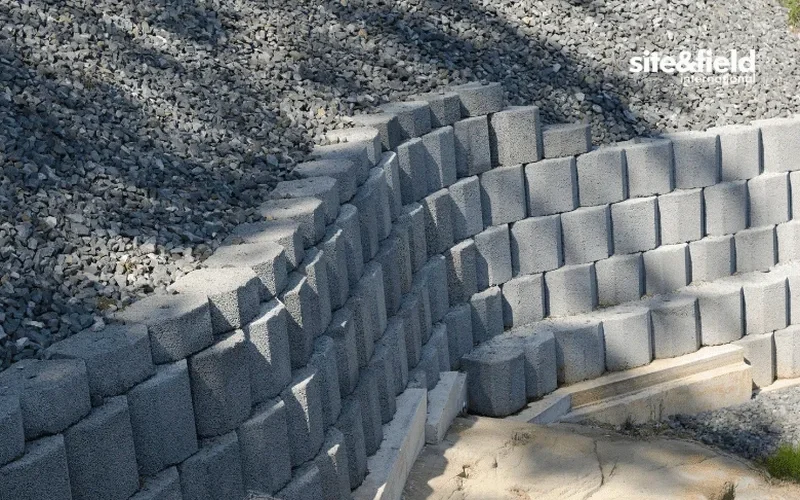
Santa Rosa sits at an elevation of 164 feet, but the real story of its terrain lies in the dramatic elevation changes across Sonoma County—from the basin floor to the steep slopes of Hood Mountain. Retaining wall design here demands more than a standard gravity solution; it requires a geotechnical understanding of the Franciscan Complex bedrock and the alluvial deposits that define the Santa Rosa Plain. The 2014 South Napa earthquake, which caused significant damage just miles away, reinforced what local engineers already knew: lateral earth pressures surge unpredictably when seismic accelerations hit soft, saturated soils. Our team works directly with contractors and structural engineers to develop retaining wall design packages that integrate site-specific soil parameters, groundwater monitoring, and the rigorous seismic provisions of ASCE 7. Whether the project involves a modest residential cut on Fountaingrove Parkway or a commercial development near Coddingtown Mall, we tailor every retaining wall design to the actual stratigraphy encountered during the subsurface investigation—never relying on assumed textbook values for a region this geologically diverse. We correlate data from SPT drilling to estimate friction angles in granular fills, ensuring the retaining wall design accounts for the true shear strength of the backfill material rather than conservative defaults that drive up construction costs.
A well-designed retaining wall balances the active earth pressure wedge against the passive resistance of the foundation, but in seismic country, that equilibrium shifts in milliseconds.
Process overview
In Santa Rosa, you often see retaining walls built after the fact—a slope cut too steep, a rainy winter exposing a weak clay seam, and suddenly the property owner needs a fix. The best retaining wall design anticipates these conditions before a shovel hits the ground. We analyze multiple failure modes: sliding at the base, overturning about the toe, bearing capacity failure in the foundation soil, and global slope instability behind the wall. For taller walls exceeding six feet, the IBC requires a design professional to seal the plans, and we back every calculation with laboratory data from our
grain size analysis and direct shear testing. Cantilever walls in the Rincon Valley area often encounter expansive clay layers that swell when wet; our retaining wall design incorporates drainage provisions—gravel blankets, perforated pipes, weep holes—that relieve hydrostatic pressure and prevent the saturated backfill condition that causes most wall failures. Mechanically stabilized earth walls, common along Highway 101 expansion projects, require careful evaluation of reinforcement pullout capacity, which we verify through
in-situ permeability testing when groundwater fluctuations might affect the reinforced zone. Every retaining wall design we deliver includes a construction observation schedule because even the most precise analysis can be undermined by poor compaction or unsuitable backfill material substituted in the field.
Questions and answers
What soil conditions in Santa Rosa most affect retaining wall design?
The Santa Rosa Plain contains interbedded alluvial clays, silts, and sands with pockets of high groundwater during winter months. Expansive clay layers in the foothills around Rincon Valley can swell when wet, increasing lateral pressure on walls. The Franciscan Complex bedrock on hillside sites has variable weathering depths, and colluvial deposits on slopes can creep over time, imposing sustained loads on the wall. A site-specific boring program identifies which of these conditions apply, and the retaining wall design adjusts the drainage strategy, reinforcement, and foundation depth accordingly.
How much does a retaining wall design cost for a residential project in Santa Rosa?
For a typical residential retaining wall design in Santa Rosa, the engineering fee ranges from US$980 for a simple gravity wall under four feet to US$4,580 for a taller cantilever or MSE wall requiring structural calculations, seismic analysis, and construction-ready stamped plans. The final fee depends on wall height, soil data availability, and whether drainage details and surcharge loads need to be modeled. We offer a fixed-fee proposal after reviewing the site conditions.
How does the IBC regulate retaining wall design in Sonoma County?
IBC Section 1807 requires retaining walls to be designed for lateral earth pressures, surcharge loads, and seismic effects. Walls over six feet in height measured from the bottom of the footing to the top of the wall need engineered plans sealed by a California-licensed professional. The City of Santa Rosa Building Division enforces these requirements and may require a soils report and special inspection during backfill placement and compaction. We coordinate directly with the building department to ensure the retaining wall design package meets all submittal requirements.
What is the design life of a properly engineered retaining wall?
A properly designed and constructed retaining wall in Santa Rosa should serve 50 to 75 years for concrete structures, assuming regular maintenance of drainage systems and no significant changes to surcharge conditions. MSE walls with polymeric geogrid reinforcement are designed for a 75-year service life when UV-protected and buried. The limiting factor is often the drainage system: if weep holes clog or the gravel blanket silts up, hydrostatic pressure builds behind the wall and can reduce its lifespan dramatically. We specify clean, open-graded drainage material and include maintenance access recommendations in every retaining wall design.