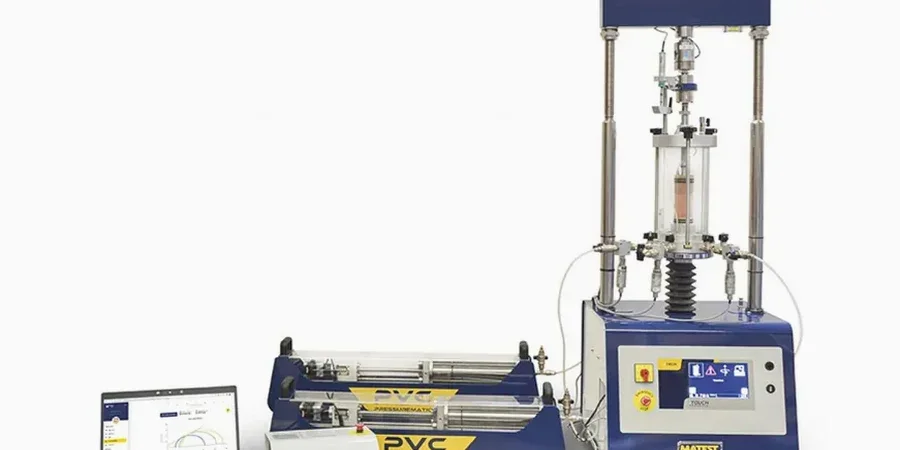
The triaxial cell sits pressurized in our lab—a clear cylinder where a Santa Rosa soil specimen, encased in a rubber membrane, gets loaded to failure. We run this test daily for projects across Sonoma County. The setup allows us to control drainage and measure pore pressure directly. Santa Rosa sits at an elevation of about 164 feet, but the subsurface varies wildly from valley alluvium to hillside weathered rock. A standard penetration test gives a blow count; the triaxial test gives the cohesion and friction angle engineers actually need for bearing capacity calculations. When the Rodgers Creek Fault runs just east of town, knowing your undrained shear strength is non-negotiable. We often pair this with in-situ CPT testing to calibrate the continuous profile against lab-derived parameters, and for pavement subgrade projects we'll run a CBR test on compacted samples.
One undisturbed sample under three confining pressures gives you the full failure envelope—that's the value of triaxial over simpler shear tests.
Process overview
Santa Rosa's post-1906 earthquake rebuild and the 1969 unification of multiple settlements created a patchwork of older fill and natural deposits. In our experience, the younger alluvium along Santa Rosa Creek often contains interbedded silts and clays that require careful triaxial interpretation. We typically run consolidated-undrained (CU) tests with pore pressure measurement on these materials—ASTM D4767 is the standard we follow. The test gives us effective stress parameters (c' and φ') even when drainage in the field is poor. For stiff clays from the Glen Ellen Formation, we may switch to consolidated-drained (CD) conditions. Sample preparation matters enormously here. We trim specimens to a 2.8-inch diameter, verify density against field conditions, and saturate them using backpressure until Skempton's B-value exceeds 0.95. A typical project requires three specimens at different confining pressures to define the Mohr-Coulomb failure envelope. For deeper investigation, we reference data from SPT drilling logs to select the most critical depths for testing.