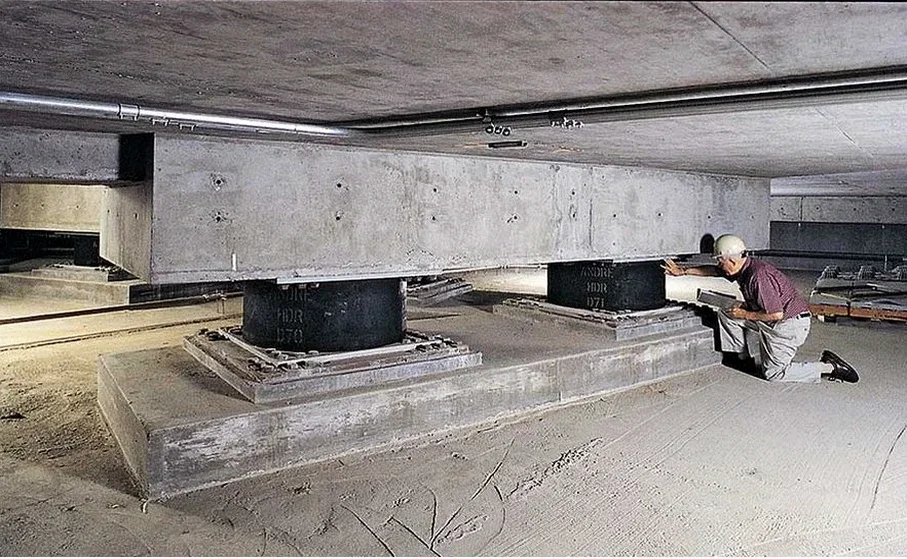
A four-story medical office building off Montgomery Drive had us on site last spring. The structural engineer flagged excessive drift under the design earthquake. Standard fixed-base detailing would not cut it. We modeled a hybrid isolation system with lead-rubber bearings and low-friction sliders. The period shift pushed the structure past two seconds. That is what base isolation seismic design demands in Santa Rosa, where the Rodgers Creek and Maacama faults bookend the city. We combined the isolation parameters with subsurface data from an in-situ permeability test to confirm no liquefiable layer sat beneath the bearing pads. The City of Santa Rosa Building Division reviewed the peer-checked package and approved it without comments.
Proper base isolation shifts the fundamental period past two seconds, cutting spectral acceleration by 60 to 80 percent in a Santa Rosa-level event.
Questions and answers
What does base isolation seismic design cost for a typical Santa Rosa project?
For a midsize building in Santa Rosa, the engineering design package including nonlinear modeling, isolator specification, peer review coordination, and testing oversight runs between US$4,630 and US$7,640. The final figure depends on structural irregularity and the number of ground motion pairs required.
Which code governs base isolation in California?
ASCE 7-22 Chapter 17 governs the analysis and design of seismically isolated structures. The 2022 California Building Code adopts it by reference, with some state-specific amendments. All our Santa Rosa submittals follow this path.
Can existing buildings in Santa Rosa be retrofitted with base isolation?
Yes. We have designed retrofit schemes where the superstructure is temporarily supported on jacking posts while the columns are cut and isolators are inserted. The process requires detailed staging analysis and continuous monitoring, but it is feasible for reinforced concrete and steel frames.
How many ground motion records are required for the analysis?
ASCE 7-22 requires a minimum of seven pairs of horizontal ground motion components. They must be scaled to match the site-specific spectrum for the Santa Rosa site class. Using fewer records forces you to take the maximum response envelope, which usually kills the design efficiency.