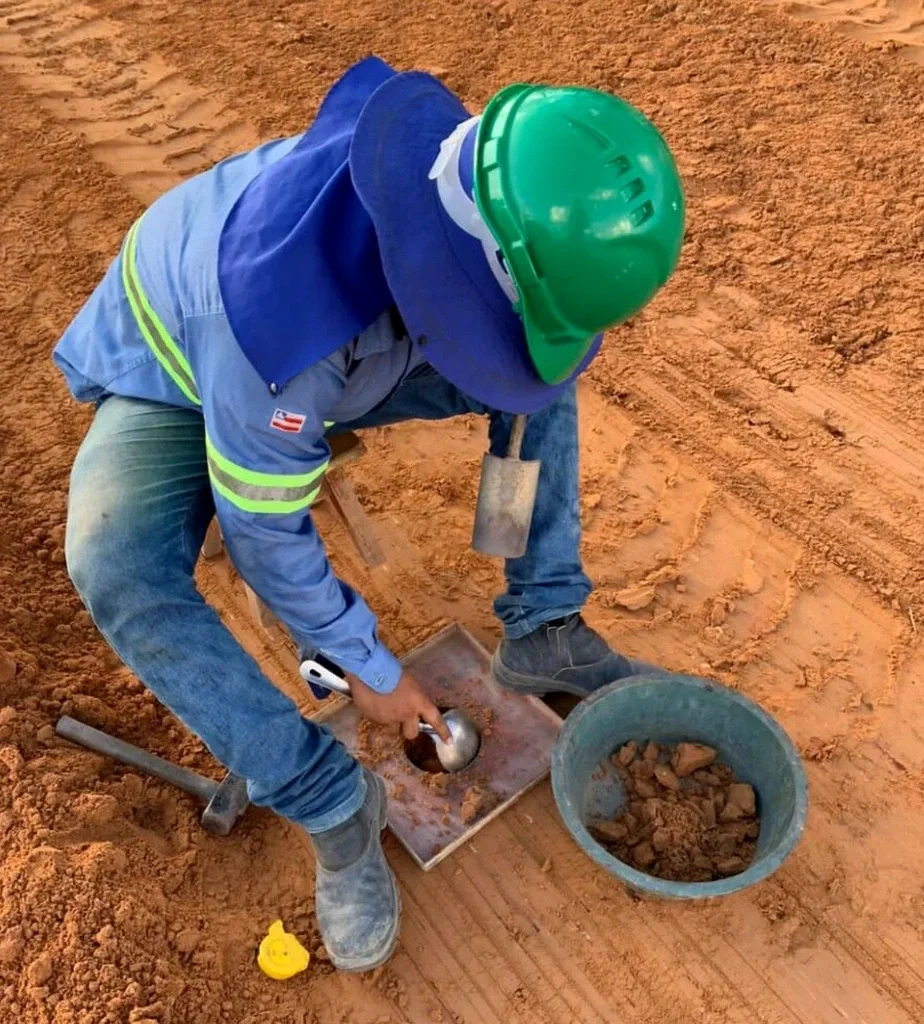
Santa Rosa sits just over 160 feet above sea level, but the real story is what lies beneath—young alluvial deposits from the Santa Rosa Creek watershed mixed with pockets of expansive clay that swell and shrink with winter rains. A 2017 USGS survey mapped Quaternary alluvium across most of the valley floor, which means variable compaction behavior from one parcel to the next. Getting a reliable field density test here isn't a checkbox exercise; it's how you avoid settlement claims six months after the retaining wall goes in. Our lab runs the sand cone method to ASTM D1556 because it gives you a direct measurement of in-place density and moisture content, no calibration curves or nuclear gauge licensing required. For trench backfill along Highway 101 corridor projects, we pair the field density data with a plate load test when the engineer needs bearing capacity confirmation on the same lift.
A sand cone test doesn't lie. You dig, you weigh, you measure—it's the gold standard for compaction verification when the soil is full of gravel and the nuclear gauge gives you funny readings.
Process overview
A costly headache we see too often in Santa Rosa: the contractor runs a nuclear gauge on clayey fill, gets a passing number, and the asphalt still cracks a year later because the gauge was calibrated for a borrow pit in Petaluma. The sand cone method doesn't have that problem—you're weighing actual soil dug from a small test hole and measuring the volume with calibrated Ottawa sand. It's direct, it's physical, and an inspector can watch every step. Our field crews carry ASTM C778 20-30 sand, pre-weighed jars, and calibrated cones that get checked against a reference mold before each project. The process follows ASTM D1556 and D698 or D1557 for the laboratory Proctor reference curve. We take moisture samples on site, seal them immediately, and oven-dry at 110°C back at the lab. That same afternoon you get a report with wet density, dry density, and percent compaction relative to the specified Proctor value—usually 95% for structural fill under footings or 98% for pavement subgrade in Santa Rosa's commercial zones.
Site-specific factors
The sand cone apparatus itself is simple—a one-gallon plastic jar threaded onto a metal cone with a cylindrical valve, plus a base plate and a digging tool. But the simplicity can fool you into cutting corners. Santa Rosa's summer heat dries out the upper few inches of fill quickly; if you don't scrape down to the actual lift you're testing, you get a false high density from a crust that formed since the roller passed. Gravelly soils common near the Fountaingrove area create another headache: a single cobble dislodged during excavation inflates the hole volume and kills your density number. Our technicians log every test hole with a photo and a short description—oversize particles, visible layering, moisture condition—so the engineer reviewing your report isn't guessing why Test Location 7 failed. For utility trench backfill in Santa Rosa's clay-rich soils, we recommend testing every 12 inches of lift, not every 24, because the margin for error on a 20-foot-deep sewer line is zero.
Relevant standards
ASTM D1556: Standard Test Method for Density and Unit Weight of Soil in Place by Sand-Cone Method, ASTM D698 / D1557: Standard Test Methods for Laboratory Compaction Characteristics (Standard & Modified Proctor), ASTM C778: Standard Specification for Standard Sand, IBC Chapter 18: Soils and Foundations, with Santa Rosa local amendments, Caltrans Standard Specifications Section 19: Earthwork
Questions and answers
What does a sand cone density test cost in Santa Rosa?
For most Santa Rosa projects, a single sand cone test runs between US$110 and US$150 per point, depending on site access and the number of tests scheduled in a day. Mobilization fees apply for small jobs with fewer than six test locations. We recommend bundling multiple lifts into one visit to keep the per-test cost at the lower end of that range.
How is the sand cone method different from a nuclear density gauge?
The sand cone method physically measures the hole volume using calibrated sand, so it isn't affected by soil chemistry, moisture variations, or the need for site-specific calibration curves that nuclear gauges require. It's also exempt from the licensing, transport regulations, and radiation safety protocols tied to nuclear devices. The trade-off is that each test takes about 15 to 20 minutes versus a minute with a gauge, but the data is direct and dispute-proof.
What compaction percentage do Santa Rosa building departments require?
Most projects in Santa Rosa follow IBC Chapter 18, with the city's building division typically requiring 95% of modified Proctor maximum dry density for structural fill under footings and slabs. Pavement subgrade and aggregate base often require 98%. For trench backfill in public right-of-way, the City of Santa Rosa Public Works Department may apply Caltrans specifications, which also default to 95% relative compaction unless the geotechnical report specifies otherwise.
How many sand cone tests do I need for my project?
The frequency is set by your project's geotechnical engineer based on fill volume and consequence of failure, but a common rule is one test per 2,500 square feet per lift, or one test per 50 linear feet of utility trench. For a typical Santa Rosa single-family home pad, expect 6 to 12 test locations. Larger commercial earthwork jobs often run 20 to 40 points across multiple lifts. We can offer a testing plan during the pre-construction meeting to align expectations.