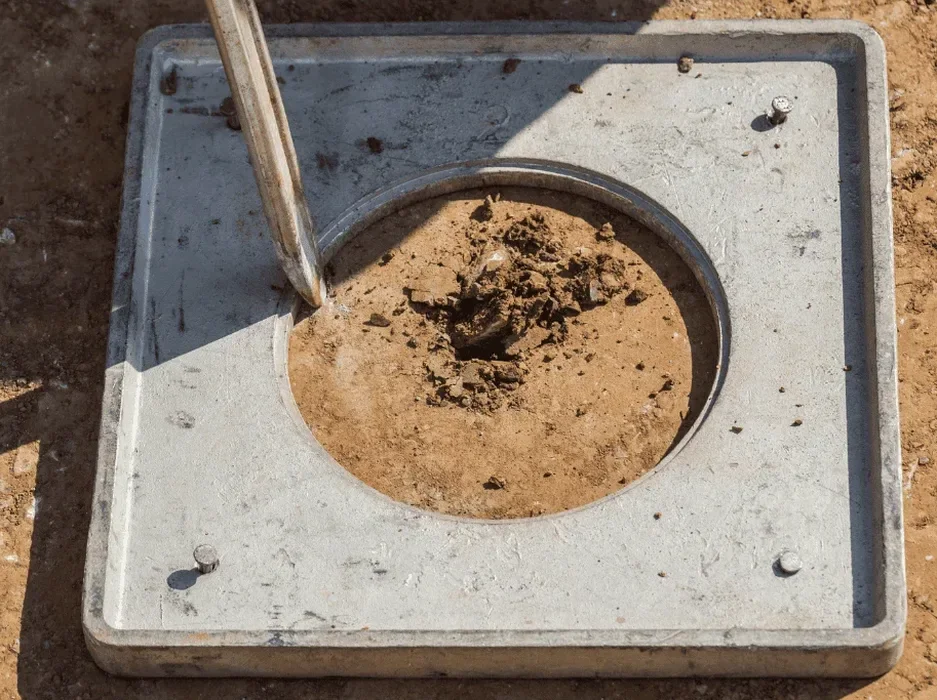
Santa Rosa sits in the Santa Rosa Plain, a fault-bounded basin filled with young Holocene alluvium from the Russian River drainage. The basin shape traps soft sediments and groundwater close to the surface, often within 10 to 15 feet. Combine that with proximity to the Rodgers Creek and Maacama faults and you have a textbook setting for seismic demand. We run soil liquefaction analysis using site-specific SPT blow counts, fines content, and groundwater monitoring data. The goal is to calculate factor of safety against liquefaction and estimate post-shaking settlement under the design earthquake. For deeper profiling where SPT data is sparse, we integrate CPT testing to capture continuous tip resistance and pore pressure records without gaps. This dual approach works well in the variable interbedded sands and silts common across Santa Rosa.
Liquefaction in Santa Rosa isn't theoretical. The 1969 Santa Rosa earthquakes triggered sand boils along Santa Rosa Creek. The hazard repeats every seismic cycle.
Site-specific factors
Many older commercial buildings in downtown Santa Rosa sit on shallow spread footings designed long before modern liquefaction codes existed. We have reviewed as-built drawings from the 1960s where bearing pressure was the only check. No one modeled excess pore pressure or loss of shear strength in the foundation soil. Today, if a geotechnical report misses liquefaction in a site class F zone, the structural engineer is designing blind. The real risk isn't just settlement. It's bearing capacity failure when shaking starts and the soil liquefies beneath the footing. We have seen sites where a thin non-liquefiable crust masked liquefiable sand below. The crust holds during static load but punches through during cyclic loading. For mitigation, densification via stone columns can work in clean sands, but the method needs verification with post-treatment CPT soundings. In silty zones, ground improvement requires more careful design.
Questions and answers
Is liquefaction analysis required for single-family homes in Santa Rosa?
The California Building Code exempts some single-family dwellings from full site-specific analysis, but given Santa Rosa's mapped liquefaction hazard zones, we typically recommend at least a screening study. If the home is in a Seismic Design Category D or E with shallow groundwater, the cost of skipping it far exceeds the cost of a targeted investigation.
What is the typical cost range for a liquefaction study in Santa Rosa?
For most commercial or mixed-use projects, a complete liquefaction analysis including field drilling, lab testing, and the engineering report runs between US$2,230 and US$4,750. The final figure depends on the number of borings, depth to competent material, and whether CPT soundings supplement the SPT program.
How deep do you investigate for liquefaction?
Standard practice follows the 50-foot depth guideline from ASCE 7. However, in the Santa Rosa basin we often extend to 60 or 70 feet when dense alluvium is not encountered. Liquefaction has been documented at greater depths in similar tectonic basins, and we base the final depth on stratigraphy, not an arbitrary cutoff.
What is the difference between liquefaction and lateral spreading?
Liquefaction is the loss of soil strength due to excess pore pressure during shaking. Lateral spreading is the horizontal displacement of a liquefied soil mass down a slope or toward a free face like a creek channel. In Santa Rosa, lateral spreading is a major concern along Santa Rosa Creek and its tributaries where bank geometry drives large permanent deformations.
How do you verify that ground improvement worked?
We run pre- and post-treatment CPT soundings at the same locations. The increase in tip resistance and sleeve friction, plus a re-run of the liquefaction triggering analysis, confirms whether the target factor of safety has been achieved. For stone columns, we also run load tests on select columns to verify stiffness improvement.