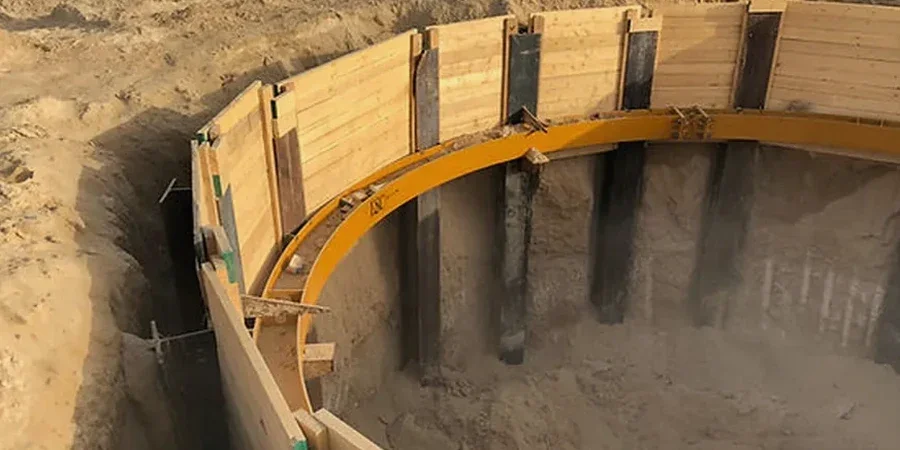
A rotary drill rig positioned near Santa Rosa Creek signals the start of a deep foundation investigation. The hollow-stem auger advances through layers of recent alluvial deposits, extracting continuous soil samples from depths exceeding 60 feet. This is standard procedure in Santa Rosa, where the transition from saturated silts of the Santa Rosa Plain to the stiffer Franciscan Complex bedrock demands precise stratigraphic definition. Each recovered split-spoon sample is logged for blow counts, a direct input for the CPT test correlations we use to refine bearing capacity estimates. The geotechnical team processes these readings alongside lab index tests, building a subsurface model that will govern pile type selection, embedment depth, and lateral load response across the site.
In Santa Rosa, pile design must reconcile the high lateral demands of a Seismic Design Category D with the abrupt vertical transitions from soft alluvium to hard rock.
Process overview
A recent multi-story residential project along Mendocino Avenue illustrated why generalized designs fail in Santa Rosa. The initial boreholes revealed 15 feet of compressible clay overlying a dense gravel layer, which in turn sat above a weathered shale formation. Driving H-piles through the gravel without pre-drilling risked refusal at variable depths, while drilled shafts needed casing through the caving clay. Our design specified 24-inch diameter cast-in-drilled-hole piles with a permanent steel casing through the upper 20 feet, socketed a minimum of 8 feet into the competent shale. We verified the rock socket capacity using the O'Neill and Reese (1999) method, a standard referenced in FHWA drilled shaft manuals, and confirmed acceptable settlement under the design earthquake using p-y lateral analyses. The pile cap was then integrated into a grade beam system to address differential movement between the tower and adjacent single-story retail units, a common challenge in mixed-use developments throughout Sonoma County.
Relevant standards
ASCE 7-22: Minimum Design Loads for Buildings and Other Structures, IBC 2021: International Building Code, Section 1810 Deep Foundations, ASTM D1143/D1143M-20: Standard Test Methods for Deep Foundation Elements Under Static Axial Compressive Load, ASTM D3689/D3689M-22: Standard Test Methods for Deep Foundation Elements Under Static Axial Tensile Load, AASHTO LRFD Bridge Design Specifications, 9th Edition, Section 10, FHWA-NHI-16-009: Drilled Shafts: Construction Procedures and Design Methods
Questions and answers
What is the typical cost range for a pile foundation design study in Santa Rosa?
A complete pile foundation design package for a typical commercial or mid-rise residential project in Santa Rosa generally falls between US$1,880 and US$5,360. The final cost depends on the number of borings, depth of exploration, lab testing requirements, and the complexity of the seismic analysis. This includes the geotechnical report with axial and lateral pile capacities, pile cap recommendations, and construction specifications.
How deep do piles typically need to go in Santa Rosa to reach competent bearing?
It varies significantly across the city. In the downtown area near Santa Rosa Creek, piles often extend 55 to 75 feet through alluvial deposits to reach dense gravel or Franciscan bedrock. Near the eastern foothills, where bedrock is shallower, depths of 30 to 45 feet can be sufficient. We always confirm depth with test borings because the contact between alluvium and bedrock can be highly irregular.
Does pile design in Santa Rosa need to account for the Rodgers Creek Fault?
Yes, absolutely. While the structure itself may be set back from the fault trace per Alquist-Priolo requirements, the entire Santa Rosa area is in a high seismic hazard zone. Our pile designs incorporate the site-specific ground motion spectra, and we check piles for curvature demands that can develop during strong shaking, especially at interfaces between soft soil and stiff rock.
Can driven piles be used in residential areas of Santa Rosa without causing damage to adjacent homes?
Driven piles do generate ground vibrations, so we conduct pre-construction condition surveys of adjacent structures and monitor vibration levels during driving using seismographs. In sensitive areas with older homes, we often shift to drilled shafts or micropiles to eliminate vibration risk entirely. The choice between driven and drilled comes down to the soil profile, access constraints, and proximity to neighboring foundations.